Snapshots about
photography
“It is not reality that photographs make immediately accessible, but
images.”
Susan Sontag

Early editions of Susan Sontag’s On Photography featured a now famous image on the cover of a couple taken in the
1850s holding up a daguerreotype of three other people. It was unbeatable for a
book devoted to the photograph as object, memory, and a concept that was not
Sontag’s originally but may have been first proposed by Baudelaire, that the
photograph represented a form of death. Clearly, the man is holding up a
portrait of three people who are no longer with them. This little snapshot is
just as powerful. If at first glance, it appears as though someone has simply
taken a snap of an existing photo, look again. Someone did that and pasted the
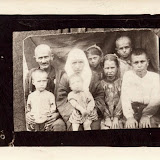
photo in an album, and then someone else photographed the album page. My guess from the clothes and the faces is that the family is Armenian and the original photo was taken around 1915, the year of the genocide. That being the case, if
there was only one existing print of the original, what required preservation
wasn’t the physical object but what it represented; the memories it contained, not just of the family but also their fate.

Sherrie Levine became a post-modernist darling in 1980 when
she re-photographed some of Walker Evan’s work, an act considered daring in its
conceptualness and which asked whether, in an age of mechanical reproduction, original
art mattered anymore. Given the choice between visiting a Levine exhibition and
one of Evans’s originals most people would choose the latter, if only because,
despite what theorists may claim, we not only still care about the original but we can tell the difference from the copy, and Levine’s work was
only a comment on that. This snapshot is much better than anything she produced
for After Walker Evans and it raises
a more subtle and pertinent question. Can we improve on the original by
reproducing it without altering its surface? There is just enough detail in the
original for us to recognize it as a portrait of a young woman, but showing the
white border of the original held at an angle was inspired. Without it we might
think it was simply a badly focused photo. Instead the original becomes
something else. If the photographer decided the result was a failure, anything
better would be a disaster.

A photo isn’t automatically interesting just because someone
in it is holding a camera. It needs some intangible quality. Here the tight
composition gives nothing away. We have no idea what the subject is that has
given the man on the right so much cause for thought, but it has been important
enough for the man on the left to walk a distance and get sand in his shoes or
aggravate his bunions. They may be press photographers for a small town
newspaper; the man on the right has the hat for the job but if they were professionals
we’d expect them to have more professional equipment. It’s that look of
concentration on his face. Something is about to happen and he needs to be
ready for it. That something could be as ordinary as his son’s baseball game or
it could be an event the rest of the world needs to know about.

We’ve all done it. That day we brought the new
camera home. flicked through the manual and loaded the film, then we looked around for
a good subject for our first photo, and spied the mirror. Nearly two centuries
after photography was invented, we still find the idea of photographing
ourselves with the camera pointed at a mirror strangely compelling. Diane Arbus
described the camera as a defence she hid behind; it protected her against the
external world. With somewhat less dramatic emphasis, that’s what happens when
we take a photo of ourselves in the mirror. The camera helps us assume a role.
That’s not him taking the photo but his reflection.

The next three photos are all about someone else
photographing the photographer; fairly common in the world of snapshots. What’s
intriguing about this one is that the photographer is playing a game but he is
in the middle of a scene we can bet is more interesting than the one he is
photographing. Here we have a group of people somewhere in Turkey; a variety of
expressions on their faces, some old cars (always good) and apartments in the
background. There’s life here, things to look at, whereas we imagine his photo
will be of his friend taking a photo. It’s a problem that goes back to Levine,
to all those questions about originality and intent: yes, that’s fine, but is
the artist missing the big picture?

The analogy between cameras and guns goes back to the early
days; John Herschel used the term ‘snapshot’ decades before it took on its
present meaning. Here we have what looks like a face off: duelling cameras. It
would be great to hunt down the opposite to this photo, and other pairs like
them, and exhibit them in a gallery. The best way would be have them face each
other, with the viewer caught in the middle. The result would almost but not
quite create a three dimensional relationship between the two subjects but more
importantly we’d get, something metaphysical; two diametrically opposed views
recorded at the moment their photos were taken.

Another Turkish snap. One of the rules of snapshots of people
taking photographs of each other is that one camera in the picture must face
the viewer otherwise it is simply a photo of people using cameras, not the
relationship between photographer and subject that becomes a game. The position
of the boy’s fingers as he holds the Brownie suggests he may not be taking a
photo, but that is a minor consideration. What makes this so good is the
confluence of the subjects. If it is not immediately obvious, the boy with the
camera is sitting on a donkey. The man on the right is carrying a rifle over
his shoulder. There’s the tight composition of the motley group, with everyone
somewhat roguish, as though the photographer stumbled across a gang of
good-natured cattle rustlers in the Anatolian wilds. From the boy’s expression
he looks like he doesn’t want his photo taken but he’s going to reciprocate
with the best defence he has. And then there’s the photographer’s shadow.

Thanks to countless manuals advising us to always photograph
with the sun behind us, snaps including the photographer’s shadow are very
common. In the best of them the shadow creates tension, and in the very best
the shadow actually transforms the photographer, usually into a sinister
presence. The composition in this photo is perfect; all the elements have a
balanced, harmonious relationship. Aeroplanes are always excellent subject
matter for snapshots but if the photographer’s shadow wasn’t here the result
would be unremarkable. What makes the whole thing work however is that the
photographer is wearing a trench coat and Homburg, the international uniform of
the secret agent. It’s like a scene from a Hitchcock thriller, where the sudden
appearance of a shadow on the tarmac ramps up the drama.
 |
| PHOTOGRAPHS OF PHOTOGRAPHY |


